
You secure long-term success in a new role by treating the first 90 days as a structured execution window focused on clarity, relationship building, and meaningful delivery.
This article gives you a decisive path for turning onboarding into early momentum. You’ll learn how to position yourself, earn trust, define your roadmap, and deliver results that establish your credibility fast.
Why are the first 90 days so important?
Your first 90 days define how you’re perceived and how quickly you become effective. They form the foundation for your reputation, internal influence, and long-term trajectory.
Hiring managers form lasting impressions based on how you show up during onboarding. When you enter with a plan—rather than observing passively—you signal preparedness and leadership. Research from onboarding case studies shows that structured ramp-ups improve retention, performance, and job satisfaction.
You create leverage by approaching these first 90 days as a business-critical opportunity—not just a training period.
How should you structure a 30-60-90 day plan?
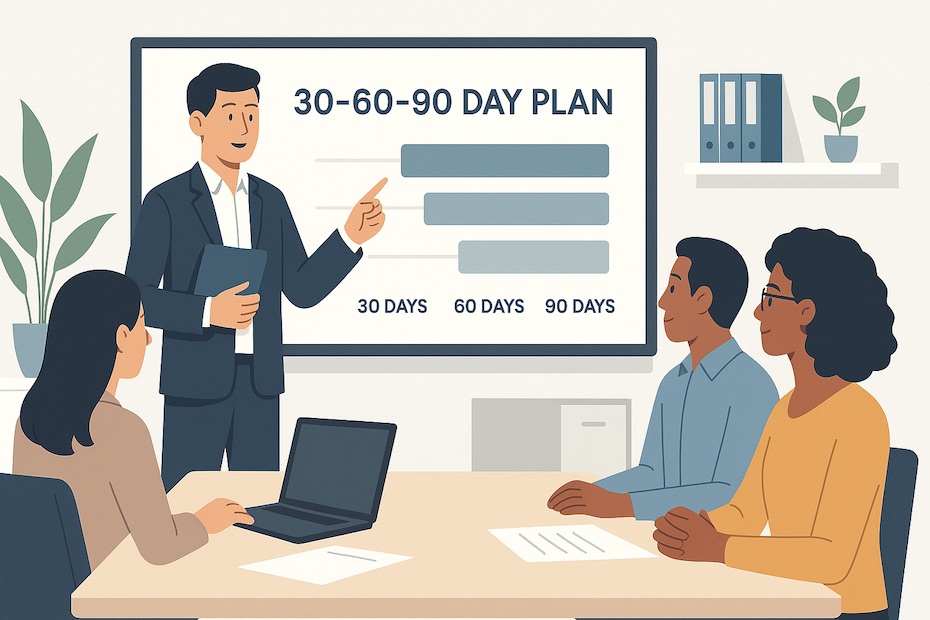
A 30-60-90 day plan helps you break down goals into three focused phases: learning, alignment, and impact. You use this framework to track progress and keep leadership informed.
In the first 30 days, your focus is to observe, absorb, and build context. Spend time with key stakeholders, attend cross-functional meetings, and document workflows. From days 31 to 60, you shift toward aligning with strategic priorities—identifying pain points and opportunities. By the final 30 days, your goal is to execute a visible win or improve a process that matters.
When you share this plan with your manager upfront, you earn alignment and feedback early—so you avoid wasting time on misaligned efforts.
Who should you build relationships with—and how?
You accelerate influence by identifying the right people to know and intentionally reaching out with purpose. Your success depends not just on what you know, but on how you integrate.
Start with your direct manager, peers, and any dotted-line collaborators. Ask for 20–30 minute conversations. Use this time to learn how they measure success, what frustrations they face, and where they see opportunities. Keep it conversational—but take notes.
When you approach others with genuine curiosity and a desire to learn—not impress—you gain critical information, build trust, and uncover early ways to add value.
What’s the fastest way to learn the role and organization?
Learning must be active. You must intentionally seek knowledge—beyond what’s handed to you in HR packets or process documents.
Shadow team members during operations. Ask for briefings on key projects. Study internal tools, metrics, and platforms. Make it your mission to learn the language, norms, and data others rely on to make decisions. Pay close attention to how meetings are run, how decisions are made, and what metrics are discussed most often.
You gain fluency by being a hands-on observer who connects dots. This fluency becomes the base for smart, targeted execution.
How do you deliver meaningful early wins?
Early wins matter—but only when they align with what your stakeholders actually value. Avoid chasing minor wins for the sake of appearances.
Look for recurring inefficiencies or friction that you can reduce. Fix something simple that saves people time or removes a blocker. Or jump in to accelerate a project that’s stalled due to a missing owner. The key is to underpromise and overdeliver on something relevant and visible.
When you deliver a well-executed win early, you’re not just showing initiative—you’re building trust. It proves that you’re here to contribute, not coast.
What are common mistakes to avoid during the first 90 days?
Overcommitting, going silent, or making assumptions will hurt your reputation quickly. These errors are more damaging early on because you haven’t yet built up goodwill.
Avoid saying yes to every task. Clarify expectations before accepting ownership. Don’t disappear into solo execution—keep your manager updated weekly with short status updates. And resist the urge to critique existing systems too quickly; learn why they exist before suggesting change.
You build long-term credibility by showing respect, pacing your delivery, and focusing on clarity—not heroics.
How do you balance learning with contributing?
Balance comes from defining one goal for each week that drives contribution and one that builds learning. You’re not expected to overhaul systems in week one—but you are expected to start moving the needle where you can.
In practice, that means you might spend mornings in onboarding modules or team briefings, and afternoons organizing a simple workflow dashboard or capturing metrics. Pair action with reflection so that your learning turns into useful output.
You grow trust when you show momentum without overreaching. Leaders notice that type of maturity.
How do you succeed in the first 90 days of a new job?
- Present a 30-60-90 day plan
- Build key relationships early
- Learn culture, KPIs, and tools
- Deliver a quick win
- Avoid overcommitting or going quiet
In Conclusion
Your first 90 days are your launch window. You maximize the opportunity when you show up with a plan, listen with intent, build relationships strategically, and deliver one meaningful result. These actions set the tone for how others see you—not just as a new hire, but as a contributor who came to make a difference.

Maurizio Chiriva Internati (DBSc, PhDs) is a cancer immunologist and biotech entrepreneur with 20+ years in immuno-oncology. Co-founder and former CEO of Kiromic BioPharma (NASDAQ: KRBP), he has led AI-driven target discovery and translational programs, and has served on faculty at MD Anderson and Texas Tech.