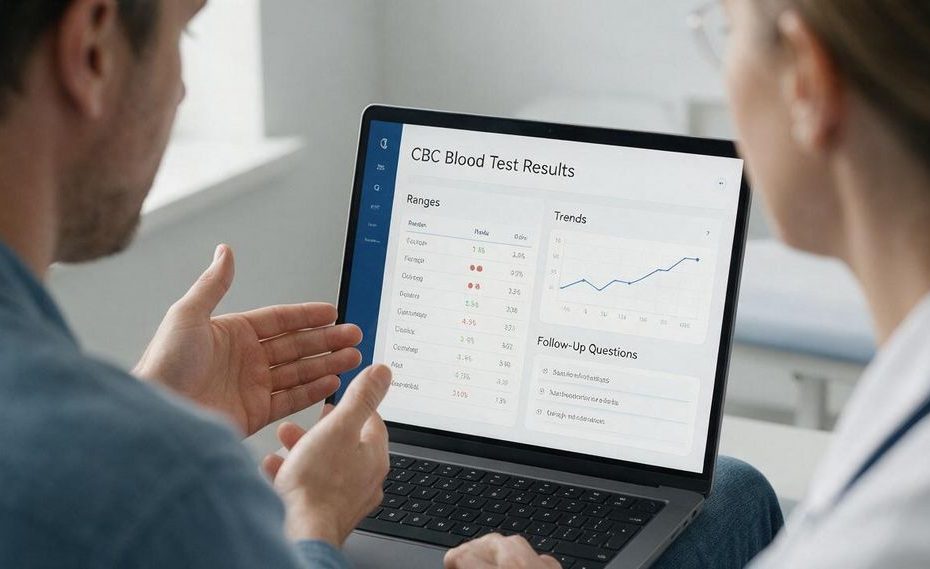
CBC blood test results should be read as a pattern: start with your lab’s reference range and units, compare earlier results, then connect the numbers with your symptoms and the reason for testing. A red, bold, or highlighted value is a prompt for review, not a diagnosis.
A complete blood count can look intimidating because it compresses many measurements into one report. You’ll get more useful information by reviewing the relationships between results rather than reacting to one isolated number. This guide explains what the main measurements mean, what can cause temporary changes, and when follow-up deserves prompt attention.
Why Is a “Red Flag” on a CBC Not a Diagnosis?
A laboratory flag means your result falls outside that laboratory’s reference interval. It doesn’t identify the cause, measure the seriousness of a condition, or confirm that anything is wrong. Healthy people can have values slightly outside a reference range, particularly when the difference is small.
Reference intervals are generally built from results found in a defined group of healthy people. They commonly cover the central 95 percent of that group, so some healthy individuals will fall outside the interval. A borderline result may reflect ordinary biological variation rather than illness.
Your clinician also reads the flagged result alongside the rest of the complete blood count (CBC). One mildly abnormal measurement surrounded by stable results often tells a different story from several related abnormalities moving in the same direction. Symptoms, medications, recent illness, hydration, and earlier test results help determine what the flag means for you.
What Does a Complete Blood Count Actually Measure?
A CBC measures the major cellular parts of your blood. It reports red blood cells, white blood cells, hemoglobin, hematocrit, platelets, and several calculations called red cell indices. A CBC with differential also separates white blood cells into specific types.
Red blood cells (RBCs) transport oxygen through your body. Hemoglobin is the oxygen-carrying protein inside those cells, and hematocrit estimates how much of your blood volume consists of red cells. These measurements are related, so clinicians usually interpret them together rather than treating each number as a separate finding.
White blood cells (WBCs) support immune responses, and platelets help your blood clot. The red cell indices describe the size of your red cells, the amount or concentration of hemoglobin they contain, and how much their sizes vary. The report gives you several views of the same blood sample, which is why the pattern matters more than a single highlighted line.
What Should You Read First on CBC Blood Test Results?
Begin with the reference range printed beside each measurement. Ranges can vary by laboratory, age, sex, pregnancy, altitude, testing method, and the population used to set the interval. A range found on another website may not match the method used for your blood sample.
Check the units before comparing your CBC blood test results with an older report. White cells and platelets may be reported as cells per microliter, thousands per microliter, or cells per liter. Hemoglobin may appear in grams per deciliter (g/dL), and cell size is often reported in femtoliters (fL). Two results can look different simply because the reports use different units.
Your personal baseline is the next place to look. A small shift from one test rarely carries the same meaning as a steady change across several tests. Compare the value with your prior results, note whether those tests were performed under similar circumstances, and look for movement across related measurements.
Recent conditions can change that comparison. Mild dehydration can concentrate the blood and raise hemoglobin or hematocrit. A recent infection may affect white blood cell counts, menstrual blood loss may lower hemoglobin, and certain medications can alter white cells or platelets. Exercise, recovery from illness, and the timing of the blood draw may also deserve consideration.
What Do Red Cell Results Mean?
Red cell results help assess your blood’s oxygen-carrying capacity and can support the evaluation of anemia. Clinicians commonly review the RBC count, hemoglobin, and hematocrit together. Low hemoglobin or hematocrit can occur with blood loss, nutritional deficiencies, chronic illness, or other causes that require evaluation rather than assumptions.
A higher hemoglobin or hematocrit can reflect dehydration because less fluid makes the cells appear more concentrated. Persistent elevations can have other causes, so repeating the test after hydration may not answer every case. Your symptoms, health history, location, and related results guide the decision about further testing.
Mean corpuscular volume (MCV) describes the average size of your red blood cells. A low MCV may be associated with iron deficiency or thalassemia, and a high MCV may be associated with vitamin B12 or folate deficiency. MCV narrows the list of possible causes, but it can’t confirm one by itself.
Mean corpuscular hemoglobin (MCH) estimates the average amount of hemoglobin in each red cell. Mean corpuscular hemoglobin concentration (MCHC) estimates how concentrated that hemoglobin is within the cells. Red cell distribution width (RDW) shows how much red cell sizes vary, which can help your clinician compare possible anemia patterns and decide whether other blood tests are needed.
What Do White Cell Results And The Differential Mean?
Your total WBC count reports the combined number of white blood cells in the sample. A higher count, called leukocytosis, may appear during an infection or inflammatory response. A lower count, called leukopenia, may be related to medications, recent illness, immune conditions, bone marrow problems, or other causes.
The total count alone doesn’t show which white cell type changed. A CBC with differential separates the count into neutrophils, lymphocytes, monocytes, eosinophils, and basophils. Each type performs a different immune function, so the differential gives your clinician more information than the total WBC count alone.
Neutrophils often receive close attention because they help respond to certain infections. Reports may include an absolute neutrophil count (ANC), which gives the measured number rather than only the percentage. Percentages can appear abnormal when another white cell type rises or falls, so absolute counts often provide a clearer reading.
Lymphocytes, monocytes, eosinophils, and basophils may shift with infections, inflammation, allergic responses, medications, and other medical conditions. A percentage outside the range doesn’t automatically mean the absolute count is abnormal. Read the percentage, absolute value, total WBC count, symptoms, and prior results together.
What Does Your Platelet Count Mean?
Platelets are cell fragments that help form blood clots. A low platelet count is called thrombocytopenia, and a high count is called thrombocytosis. The degree of change, related symptoms, and whether the result persists help determine its meaning.
A mildly altered platelet count may be temporary. Recent illness, inflammation, medications, blood loss, and laboratory factors can affect the result. Platelets can also clump in the collection tube, which may produce a reading that appears lower than the true count and leads to a repeat test.
Platelet numbers don’t tell the full story about clotting. A person can have a platelet count within the reference interval and still need evaluation for unusual bleeding, bruising, or clotting symptoms. The count must be read with your medical history, current medicines, and other test findings.
Trends deserve particular attention. A stable result that has remained mildly outside the range for years can carry a different meaning from a rapid drop or rise. Your clinician may repeat the CBC, review a blood smear, or order related testing when the pattern calls for a closer look.
When Should Abnormal CBC Results Prompt Follow-Up?
Follow-up becomes more important when an abnormal result persists, changes substantially, or appears with other abnormal blood counts. Several low cell lines at the same time require a different review from one borderline measurement. A repeat CBC can show whether the finding was temporary, stable, or moving further from your baseline.
Contact your clinician when abnormal results occur with unexplained fever, unintentional weight loss, night sweats, severe fatigue, easy bruising, or unusual bleeding. These symptoms don’t point to one diagnosis, but they give the laboratory findings greater medical relevance. Your clinician can assess how quickly you need additional testing.
Prepare for the discussion by asking whether the result is mildly or markedly outside the laboratory range, whether it has changed from your baseline, and whether related measurements support the same pattern. Ask if recent illness, hydration, menstrual blood loss, exercise, or medication could have affected the result. You can also ask whether the CBC should be repeated and whether another test is needed to identify the cause.
A normal CBC doesn’t guarantee that every part of your health is normal, just as one abnormal value doesn’t prove that you’re ill. The test answers specific questions about blood cells and related measurements. Your symptoms, examination, health history, and other tests remain part of the assessment.
What Should You Check First On A CBC Report?
- Check your lab’s reference range
- Note the units, including cells/mcL and g/dL
- Compare with previous results
- Consider symptoms, not one isolated value
Read The Pattern Before You React To The Flag
Your CBC blood test results make more sense when you read the reference range, units, personal baseline, and related measurements before focusing on highlighted values. Red cells, white cells, and platelets each provide a different part of the picture, but no single number tells the whole story. Temporary factors can shift a result, and small deviations are not automatic evidence of disease. Persistent changes, multiple abnormal cell lines, or concerning symptoms deserve follow-up with your clinician. Use the report to guide better questions, not to make a diagnosis from a red mark in a patient portal.
References
- MedlinePlus: Complete Blood Count
- Mayo Clinic: Complete Blood Count
- Cleveland Clinic: Complete Blood Count
- National Heart, Lung, and Blood Institute: Blood Tests
- American Society of Hematology: Blood Basics
- Testing.com: Complete Blood Count.

Maurizio Chiriva Internati (DBSc, PhDs) is a cancer immunologist and biotech entrepreneur with 20+ years in immuno-oncology. Co-founder and former CEO of Kiromic BioPharma (NASDAQ: KRBP), he has led AI-driven target discovery and translational programs, and has served on faculty at MD Anderson and Texas Tech.