
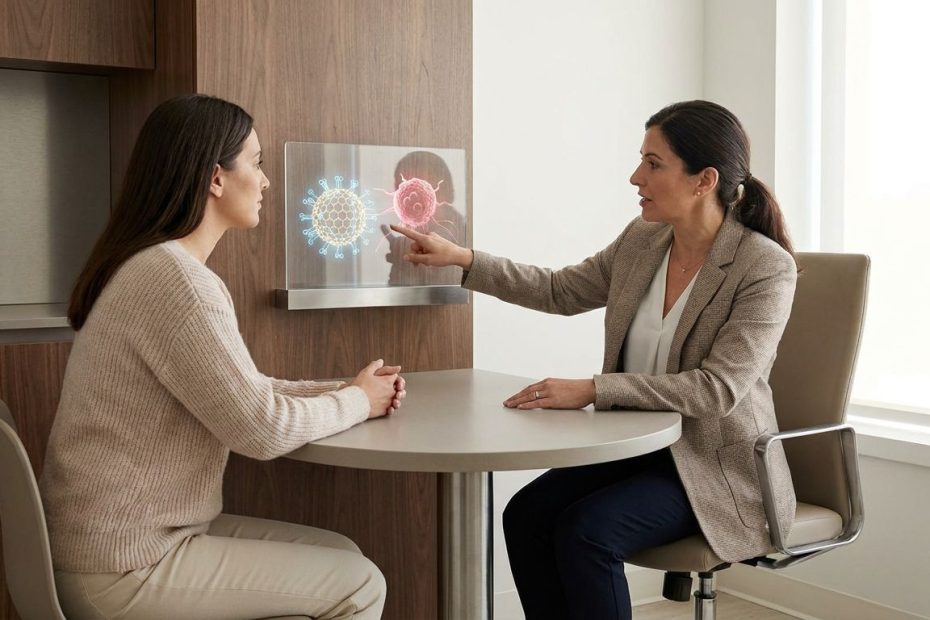
Nanotechnology in medicine is changing cancer treatment delivery by using nanoscale carriers to move drugs through the body in more controlled ways. In cancer care, that usually means liposomes, albumin-bound particles, polymer-based systems, and other nanocarriers rather than tiny machines inside the body.
You’re likely searching for a grounded answer: what’s real, what’s approved, what’s still experimental, and whether nanoparticle drug delivery can reduce side effects. This article explains how cancer nanomedicine works, why delivery is so hard, which nano-based treatments already exist, and where the science still has limits.
What Is Nanotechnology In Cancer Medicine?
Nanotechnology in cancer medicine uses materials engineered at very small scales to improve how cancer drugs, imaging agents, and treatment-enhancing particles behave in the body. The goal is usually better delivery, better targeting, better monitoring, or a better balance between tumor effect and damage to healthy tissue.
The National Nanotechnology Initiative defines nanotechnology around the control of matter at roughly 1 to 100 nanometers, where materials can act differently than they do at larger sizes. In drug development, the Food and Drug Administration also considers broader size-related behavior, since some drug products with nanomaterial properties can fall outside that narrow range. Size matters, but it’s not the only factor. Shape, surface charge, coating, stability, and release behavior can all change how a cancer medicine performs.
In practice, cancer nanotechnology is less like science fiction and more like advanced formulation science. A drug may be packed into a lipid bubble, attached to a polymer, bound to albumin protein, or combined with a particle that supports radiation treatment. These systems are designed to change circulation time, tissue distribution, drug release, and interaction with tumors.
The reason this matters is simple: cancer treatment often fails not because a drug has no activity, but because too little reaches the right cells at the right concentration for the right amount of time. Nanoparticle drug delivery tries to improve that equation. It doesn’t make cancer easy to treat, but it gives clinicians and researchers more control over how therapy is delivered.
Why Is Drug Delivery One Of Cancer Treatment’s Biggest Problems?
Drug delivery is difficult because cancer drugs must reach tumor tissue without causing unacceptable harm to normal tissue. A treatment can look promising in a lab and still struggle inside the body because blood flow, immune clearance, organ uptake, and tumor biology all affect where the drug goes.
Many standard cancer drugs circulate through the bloodstream and affect fast-dividing cells in more than one part of the body. That can help attack tumors, but it can also affect bone marrow, digestive tissue, hair follicles, nerves, and other healthy systems. Nanotechnology in medicine aims to change drug exposure, not simply make drugs stronger.
The global need for better treatment delivery is large. International cancer agencies estimate about 20 million new cancer cases and 9.7 million cancer deaths worldwide in one recent global count. In the United States, cancer projections exceed 2 million new cases and 600,000 deaths in a recent annual estimate. Those numbers are not just statistics; they explain why better delivery systems matter.
Delivery also varies from tumor to tumor. A drug that penetrates one tumor type may perform differently in another because blood vessels, pressure inside the tumor, immune activity, and tissue structure can differ. That’s one reason nanotechnology in cancer treatment is not a single product or cure. It’s a set of delivery tools that must be matched to the drug, cancer type, dose, treatment plan, and patient.
How Do Nanoparticles Deliver Cancer Treatments?
Nanoparticles deliver cancer treatments by carrying a drug or treatment-enhancing material through the body and changing how it circulates, accumulates, releases, and interacts with cancer tissue. Some systems rely on passive accumulation near tumors, and others are designed for more directed interaction with cancer-related targets.
A common design is the liposome, a tiny lipid-based sphere that can hold a drug and alter how quickly it spreads through the body. Liposomal chemotherapy can reduce exposure to certain healthy tissues compared with some conventional formulations, though it can still cause side effects. Albumin-bound particles use a natural blood protein to carry a drug in a different formulation. Polymer-based systems can attach or hold drugs in ways that influence release and circulation.
Many solid-tumor nanocarriers are built around the enhanced permeability and retention effect. This idea is based on the observation that some tumor blood vessels are leakier than normal vessels and that tumor tissue may retain particles differently. The concept is useful, but it is not a guarantee. Human tumors vary, and nanoparticle delivery can be limited by blood flow, dense tissue, immune uptake, and poor penetration beyond the outer tumor regions.
Researchers also study active transport and retention, where nanoparticles interact with biological processes that help movement into or retention within tumors. Some designs use surface features intended to bind to cancer-related markers. Others combine therapy and imaging, allowing treatment monitoring alongside delivery. The common goal is more control over where the treatment goes and how it acts once it arrives.
Is Nanotechnology Already Used In Cancer Treatment?
Yes, several nanotechnology-based cancer medicines are already used in clinical care, and many more are being tested in clinical trials. The field is not purely experimental, but it’s also not a universal replacement for standard chemotherapy, surgery, radiation therapy, immunotherapy, or targeted therapy.
The National Cancer Institute lists multiple approved nano-based cancer therapies, including liposomal drugs, albumin-bound formulations, polymer-related products, iron oxide systems, and hafnium oxide nanoparticle approaches. Doxil and Abraxane are two widely recognized examples. Other products include Onivyde, Vyxeos, Marqibo, DaunoXome, DepoCyt, Oncaspar, NanoTherm, Hensify also known as NBTXR3, Pazenir, Genexol-PM, and Mepact in approved-use listings across different regions.
Doxil is a liposomal form of doxorubicin. Abraxane is paclitaxel bound to albumin particles and is used in several cancers, including breast cancer, pancreatic cancer, and non-small cell lung cancer. Onivyde is a liposomal irinotecan product used in gastrointestinal cancer treatment settings. Vyxeos combines cytarabine and daunorubicin in a liposomal formulation for acute myeloid leukemia.
The practical point for you is that “nano” can mean many different drug designs. One nanomedicine may change heart-related toxicity patterns, another may avoid certain solvents, and another may alter dosing or tumor exposure. You should never assume that all nanoparticle medicines share the same benefits or risks. The formulation matters.
Can Nanotechnology Reduce Cancer Treatment Side Effects?
Nanotechnology can reduce some toxicities for some drugs, but it does not remove side effects. A nanoparticle formulation changes the body’s exposure to a treatment, which can improve the safety profile in one area and introduce different risks in another.
This is one of the most common patient questions, and it deserves a careful answer. If a drug is packaged inside a nanocarrier, less of it may reach certain healthy tissues in its free form. That can be helpful. Yet the drug is still active, the immune system still responds to foreign or engineered materials, and organs involved in clearance can still be exposed.
Side effects depend on the drug, carrier, dose, infusion schedule, route, cancer type, and patient health. A liposomal drug may cause a different pattern of skin, mouth, infusion, blood count, or organ-related effects than the conventional version. Albumin-bound paclitaxel avoids some formulation issues linked with older paclitaxel preparations, but it can still cause neuropathy, low blood counts, fatigue, and other treatment-related problems.
So the better question is not, “Does nanotechnology mean no side effects?” The better question is, “Does this nanoformulation improve the benefit-risk balance for this cancer and this patient?” That’s the standard your oncology team uses when comparing treatment options.
Why Is Tumor Targeting Harder Than It Sounds?
Tumor targeting is hard because nanoparticles do not automatically travel straight to cancer cells. They move through blood, interact with proteins, face immune clearance, collect in organs, and must pass through tumor blood vessels and tissue barriers before they can deliver their payload.
A well-known meta-analysis found that nanoparticle tumor delivery efficiency was often low, with mean and median tumor delivery efficiencies of 2.23 percent and 0.76 percent of injected dose at the last sampling point across hundreds of datasets. That finding does not mean nanomedicine fails. It means delivery is a demanding biological problem, and small improvements can still matter when paired with the right drug and dose.
The enhanced permeability and retention effect also varies widely. Some tumors have leaky vessels, but others have poor blood flow, dense stroma, raised internal pressure, or barriers that limit particle entry. A nanoparticle may collect near tumor blood vessels yet fail to penetrate deeply enough into tumor tissue. That difference can shape how well a treatment works.
This is why modern cancer nanomedicine is moving beyond simple “make it small and it will target tumors” thinking. Researchers now compare particle size, surface chemistry, drug release rate, immune interaction, tumor penetration, and patient-specific tumor biology. The most useful systems will be the ones that solve a defined delivery problem, not the ones that sound most futuristic.
What Else Can Nanotechnology Do Beyond Chemotherapy Delivery?
Nanotechnology can support cancer imaging, radiation enhancement, treatment monitoring, and combined diagnostic-treatment strategies. Drug delivery is the best-known use, but it is not the only role for nanoscale medicine in oncology.
The National Cancer Institute describes nanotechnology applications in cancer prevention, diagnosis, treatment, and monitoring. Some nanoparticle systems are designed to improve imaging contrast, helping clinicians see tumors or treatment effects more precisely. Others are built to make radiation therapy more effective by increasing local energy effects inside or near tumor tissue.
Hafnium oxide nanoparticles are one example of a treatment-enhancing strategy rather than a classic drug carrier. These particles are used with radiation in certain treatment settings to increase local tumor cell damage after external activation. Iron oxide particles and other nanomaterials have also been explored for imaging or heat-based treatment approaches.
Theranostics is another important concept, where a system combines therapy and diagnostics in a coordinated way. In cancer care, that could mean tracking whether a particle reaches a tumor, measuring treatment distribution, or linking imaging information to treatment decisions. This area is still developing, but it fits the central promise of nanotechnology in medicine: better information and better delivery at the same time.
How Are Safety, Regulation, And Manufacturing Handled?
Nanotechnology cancer products are evaluated case by case for safety, efficacy, and quality. Regulators do not treat nanomaterials as automatically safe or automatically dangerous; they examine the final product, its behavior, its manufacturing controls, and its clinical evidence.
The Food and Drug Administration emphasizes that nanomaterial-containing drugs must meet the same standards as other drug products. At the same time, these products can raise extra questions about particle size, distribution, surface properties, stability, sterility, batch consistency, and scale-up. A small change in manufacturing can change how a nanoparticle behaves in the body.
Safety testing also includes biodistribution: where the particles go, how long they remain, how they break down, and how the body clears them. The National Cancer Institute’s Nanotechnology Characterization Laboratory supports preclinical characterization and safety testing for cancer-related nanoparticles. It has worked with more than 125 investigators worldwide and evaluated more than 500 unique nanoparticles for cancer applications.
This careful testing is one reason lab discoveries take time to become approved treatments. A promising particle must be reproducible, stable, scalable, and clinically useful. It must also prove that its added complexity delivers a real treatment advantage.
What Should You Ask Before Considering A Nanotechnology-Based Cancer Treatment?
You should ask whether the treatment is approved for your cancer type, offered through a clinical trial, or still in early research. You should also ask what benefit the nanoformulation is meant to provide compared with a standard version or another available treatment.
Useful questions include: What drug or particle is being used? Is it liposomal, albumin-bound, polymer-based, or another type? What cancer type and treatment setting is it intended for? What side effects are common? What side effects are different from the conventional drug? These questions help you move past the word “nano” and focus on the treatment decision.
If the option is a clinical trial, ask about the trial phase, eligibility rules, treatment schedule, monitoring, possible costs, travel needs, and what happens if the cancer progresses. Clinical trials are an important route for new nanomedicine strategies, but they are not the same as approved routine care. Your oncology team can help compare trial participation with standard treatment options.
Also ask what outcome the treatment is designed to improve. Some nanomedicines aim to increase tumor exposure. Others aim to reduce a specific toxicity, enable a different dose schedule, improve imaging, or enhance radiation treatment. A clear answer to that question tells you whether the technology addresses a problem that matters for your care.
How Is Nanotechnology Used In Cancer Treatment Delivery?
- Packages drugs in nanoscale carriers
- Changes circulation and release
- Can increase tumor exposure
- Can reduce some toxicity, not all
What The Future Of Cancer Nanomedicine Really Depends On
The future of nanotechnology in medicine will depend on better delivery evidence, smarter patient selection, safer designs, and manufacturing that can produce consistent products at clinical scale. The field has already moved beyond theory, with approved cancer nanomedicines in use and many newer strategies under testing. The strongest progress will come from matching the right carrier to the right drug, cancer type, and treatment goal. If you’re evaluating a nano-based therapy, focus less on the label “nanotechnology” and more on the evidence: what it delivers, where it goes, what benefit it adds, and what risks remain.
References
- National Nanotechnology Initiative: About Nanotechnology
- National Cancer Institute: Nanotechnology In Cancer
- National Cancer Institute: Cancer Nano-Therapies In The Clinic And Clinical Trials
- National Cancer Institute: Safety Of Nanotechnology Cancer Treatment
- Food And Drug Administration: Considerations For Drug Products That Contain Nanomaterials
- Food And Drug Administration: Approach To Regulation Of Nanotechnology Products
- International Agency For Research On Cancer: Global Cancer Burden
- American Cancer Society: Cancer Facts And Figures
- ACS Nano Meta-Analysis: Nanoparticle Delivery To Tumors
- Nature Reviews Bioengineering: Nanoparticle Delivery To Tumours
- ClinicalTrials.gov: Nano-SMART Study
- Food And Drug Administration Label: Abraxane

Maurizio Chiriva Internati (DBSc, PhDs) is a cancer immunologist and biotech entrepreneur with 20+ years in immuno-oncology. Co-founder and former CEO of Kiromic BioPharma (NASDAQ: KRBP), he has led AI-driven target discovery and translational programs, and has served on faculty at MD Anderson and Texas Tech.