
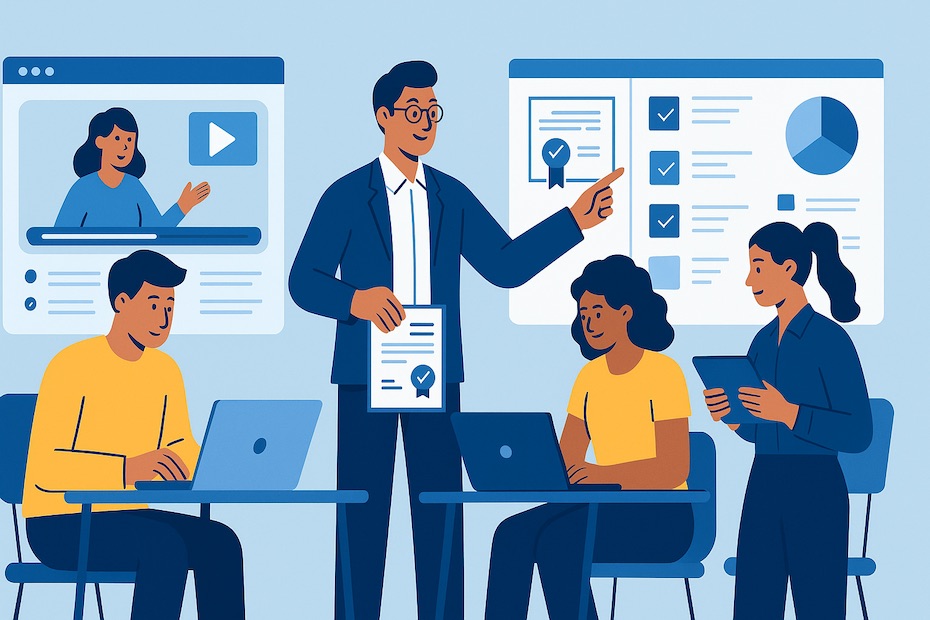
You prepare your career for the future by upskilling to deepen your strengths and reskilling to pivot when market demand shifts. These strategies protect your relevance and mobility.
This article walks you through what real professionals want to know: how to identify the right skills, where to begin, and how to sustain meaningful growth that drives long-term career value.
What is the difference between upskilling and reskilling?
Upskilling strengthens your current skill set to help you stay competitive in your role. Reskilling prepares you to take on a new role by learning an entirely different set of capabilities.
For example, if you work in digital marketing and learn advanced SEO automation or AI-powered analytics, you’re upskilling. But if you move from finance to cybersecurity and train in threat analysis, that’s reskilling. You’re not adding to your current toolkit—you’re building a new one.
The key distinction lies in direction: upskilling is vertical growth, reskilling is lateral movement. Both support adaptability and resilience in an unstable labor market.
Why is future-proofing your skills non-negotiable?
Automation, AI, and demographic shifts are forcing change faster than traditional career paths can keep up. According to the World Economic Forum, 44% of workers’ core skills will shift by 2027. That’s not optional. It’s already happening.
McKinsey reports that 87% of companies are either facing skills gaps or expect them within a few years. Most roles are being redefined rather than replaced. You don’t need to start over—but you do need to start preparing.
Future-proofing your career is about getting ahead of job dislocation, not reacting to it. The most resilient professionals are those who treat learning as a continuous process, not a corrective one.
How do you know what skills to learn?
Start by auditing your industry and function. Use job boards, LinkedIn’s “Career Explorer,” or Coursera’s Skills Dashboard to assess trending roles and what they require.
Then assess your current position—what technologies are emerging, which certifications are becoming standard, and what your competitors are learning. Look for overlaps between what’s rising in value and what aligns with your interests or future goals.
A structured approach helps:
- Define 1–2 target future roles or functions
- Map the key hard and soft skills they demand
- Prioritize skills that align with automation, AI integration, or cross-functional fluency
- Validate with a mentor or industry leader
This process brings clarity and eliminates guesswork.
Where should you begin your upskilling or reskilling journey?
Use modular, stackable resources instead of enrolling in broad academic programs. Short-form courses, certifications, and applied projects offer quicker ROI and reduce opportunity cost.
Start with platforms like:
- LinkedIn Learning for leadership and productivity
- Coursera or edX for industry-aligned certificates (e.g., Python, cybersecurity, data science)
- Google Career Certificates, AWS Academy, or IBM SkillsBuild for cloud, analytics, and IT roles
You can also gain ground by volunteering on internal cross-functional projects or shadowing team leads in different departments.
The goal isn’t accumulation—it’s relevance. Focus on gaining capabilities that let you solve higher-order problems or contribute to business strategy.
What are the long-term benefits of upskilling or reskilling?
Aside from retaining employability, you gain increased autonomy, internal mobility, and income leverage. IBM found that employees who develop new skills through company-sponsored programs are 15% more likely to receive promotions and 30% less likely to quit.
HR executives also confirm it: upskilling is now seen as a driver of enterprise performance. A PwC report shows 93% of CEOs who invested in workforce upskilling saw improved productivity, innovation, and retention.
Whether you’re building toward leadership, shifting functions, or preparing for entrepreneurial ventures, continuous skill development keeps your options open.
What’s the biggest barrier to consistent progress?
The biggest obstacle isn’t resources—it’s inertia. Most professionals delay action until disruption becomes unavoidable. Others burn out quickly due to unstructured learning with no feedback or measurable progress.
To avoid these traps:
- Build a weekly learning schedule
- Create SMART learning goals (Specific, Measurable, Achievable, Relevant, Time-bound)
- Pair skills acquisition with direct application on the job
- Track wins and milestone completions publicly
Accountability drives consistency. If your company doesn’t support structured upskilling, build a peer group or join a mastermind circle to reinforce follow-through.
How do companies benefit from employee upskilling?
When companies invest in workforce development, they gain agility. Instead of hiring externally every time a new technology arises, they can redeploy high-performing staff faster and cheaper.
A Deloitte study found companies with strong learning cultures are 92% more likely to innovate, 52% more productive, and 17% more profitable. That makes upskilling not just a benefit, but a strategic imperative.
Leading organizations like Amazon, Accenture, and Capgemini have already committed billions to retrain their workforce internally. The business case is now proven.
What are the most in-demand upskilling areas right now?
According to LinkedIn’s 2025 Future of Skills report and Coursera’s Skills Index:
- Data Analysis and Visualization (Power BI, Tableau, Excel modeling)
- Cloud Computing (AWS, Azure, Google Cloud)
- Cybersecurity Foundations
- AI & Prompt Engineering
- Leadership Communication and Remote Team Management
Even non-technical professionals benefit from cross-training in data fluency, digital communication tools, and agile project management—skills that touch every department.
Practical focus areas you can act on
- Analyze emerging roles and career trajectories
- Select one technical and one soft skill to prioritize
- Allocate 2–4 hours per week for learning
- Choose a platform with practical application exercises
- Document skill gains and share with your network or employer
- Link new skills to real business impact whenever possible
How to prepare your career for the future with upskilling and reskilling?
- Audit skills required for emerging roles
- Learn through certifications and projects
- Apply skills in your current job
- Track progress and share outcomes
In Conclusion
You future-proof your career by taking control of your learning. Whether you’re doubling down on your strengths or pivoting entirely, upskilling and reskilling give you the leverage to thrive—not just survive—in tomorrow’s economy.
For STEM professionals looking to accelerate their upskilling journey, explore the Maurizio Chiriva International STEM Scholarship – supporting technical education and career transitions in high-growth fields like AI, data science, and renewable energy.

Maurizio Chiriva Internati (DBSc, PhDs) is a cancer immunologist and biotech entrepreneur with 20+ years in immuno-oncology. Co-founder and former CEO of Kiromic BioPharma (NASDAQ: KRBP), he has led AI-driven target discovery and translational programs, and has served on faculty at MD Anderson and Texas Tech.